Installation Durability Assessment -TELUS Spark Science Centre
Overview
TELUS Spark is a major science center in Calgary that operates dozens of interactive exhibits designed for continuous public use. During an April 2026 visit, I conducted an independent durability observation of four installations spanning different design philosophies, interaction types, and levels of mechanical complexity.
This is not a commissioned assessment. No disassembly, instrumentation, or internal documentation was available. All observations are external, based on what a durability engineer can infer from visible hardware, user interaction patterns, and exhibited condition during normal operating hours.
The value of this kind of observation is pattern recognition. Every interactive installation eventually confronts the same fundamental tension: guests do not use things the way designers intend. Durability engineering is the discipline of designing for what people actually do, not what signs tell them to do.
Installation 1: Circuit Building Interactive
What It Is
A tabletop exhibit where guests build electrical circuits by connecting model houses to power transmission towers using alligator clip leads. When a circuit is completed correctly, LEDs inside the model houses illuminate. The exhibit teaches basic electrical circuit concepts, including series vs. parallel connections and open vs. closed circuits, through hands-on experimentation.
What I Observed

The alligator clip leads appeared to be standard off-the-shelf components, not ruggedized or custom-designed for public use. Several clips showed loose jaw tension, which would cause intermittent connections and frustrate guests who build a correct circuit but get no feedback. Wires were tangled and overlapping across the table surface, with some leads stretched between distant connection points.
The model houses are lightweight, likely made of laser-cut acrylic or thin plastic, and were clustered and pushed together through repeated handling. The transmission tower models are more robust with metal construction, but the alligator clip attachment points at the top of each tower are the mechanical weak link.
Durability Assessment
This exhibit follows a consumable component philosophy. The design accepts that alligator clips, wires, and possibly the model houses themselves will degrade and require regular replacement. This is a legitimate design strategy; it keeps fabrication costs low and allows rapid refresh, but it increase maintainance costs.
The durability implications of this approach are worth understanding:
Clip degradation is the primary failure mode.
Alligator clips lose jaw tension through repeated open/close cycles. In a public science center seeing hundreds of daily users, standard clips may lose reliable contact within weeks. The educational experience depends entirely on electrical continuity; a loose clip doesn't just degrade the experience, it breaks it completely, because the guest cannot distinguish between "my circuit is wrong" and "this clip doesn't work."
Tangling is a design-level problem, not a user behavior problem.
With multiple leads on an open table, tangling is inevitable. A durability-oriented redesign might consider magnetic connection points instead of clips, or channeled wire paths built into the table surface. Each of these increases fabrication cost but reduces the daily staff time currently spent untangling and replacing leads.
The model houses absorb cumulative handling damage.
Lightweight enclosures picked up, rotated, dropped, and stacked by children will show surface wear, crack at stress concentrations, and eventually lose their LEDs to wire fatigue at solder joints. Replacement frequency depends on material and construction quality, but these should be treated as consumable items with a planned replacement cadence rather than permanent exhibit elements.
What a Durability Engineer Would Recommend
For a next-generation version of this exhibit, the highest-impact changes would be: replacing alligator clips with a purpose-built connection mechanism (magnetic pogo pins or spring-loaded banana jacks) rated for 100,000+ cycles; constraining wire routing to prevent tangling; and designing the house enclosures for drop resistance with strain-relieved internal wiring. These changes would increase per-unit fabrication cost, but could reduce weekly maintenance labor significantly.
Installation 2: Construction Crane Exhibits
What They Are
Two construction-themed exhibits that share visual theming but operate independently.
The first is a model tower crane inside a plexiglass enclosure, sitting on a construction-site diorama with miniature building materials. The crane appears to be controlled remotely, likely from a nearby interface.
The second is a cockpit simulator with joysticks and a screen running a 3D crane simulation game. The cockpit screen content does not correspond to the model crane's movements; these are separate exhibits.

What I Observed
The plexiglass enclosure around the model crane is intact and clean, effectively protecting the delicate crane mechanism from direct guest contact.
The cockpit simulator presents a standard screen-based gaming interface with physical joystick controls. I did not closely inspect the joystick hardware or seat condition.
Durability Assessment
The most interesting observation here is not about either exhibit individually, it is about design separation as a durability strategy.
Whether intentional or the result of scope reduction during development, the independence of these two exhibits is a durability advantage. An integrated system in which the cockpit physically controls the model crane would create a cross-domain failure mode: a software bug, a signal latency issue, or a mechanical jam in the crane would take down the entire experience. By decoupling them, each exhibits failure independently. The cockpit's wear items (joystick potentiometers, seat upholstery, screen) are commodity components that are straightforward to replace. The model crane's mechanical components (cable spool, hoist motor, slew mechanism) are protected behind plexiglass and require attention only when the mechanism itself degrades.
The plexiglass enclosure is the key durability decision. It physically separates the fragile crane mechanism from guest interaction forces. Without it, the crane boom, cable, and counterweight would be grabbed, bent, and broken within hours of opening. The enclosure trades direct tactile engagement for mechanical survival.
What a Durability Engineer Would Recommend
Ensure plexiglass is secure; this was a critical durability feature. The cockpit simulator's joysticks should be industrial-grade (hall-effect sensors rather than potentiometers) to avoid drift and dead zones developing over time.
Installation 3: KUKA Robotic Arm Ride ("Rosie")
What It Is
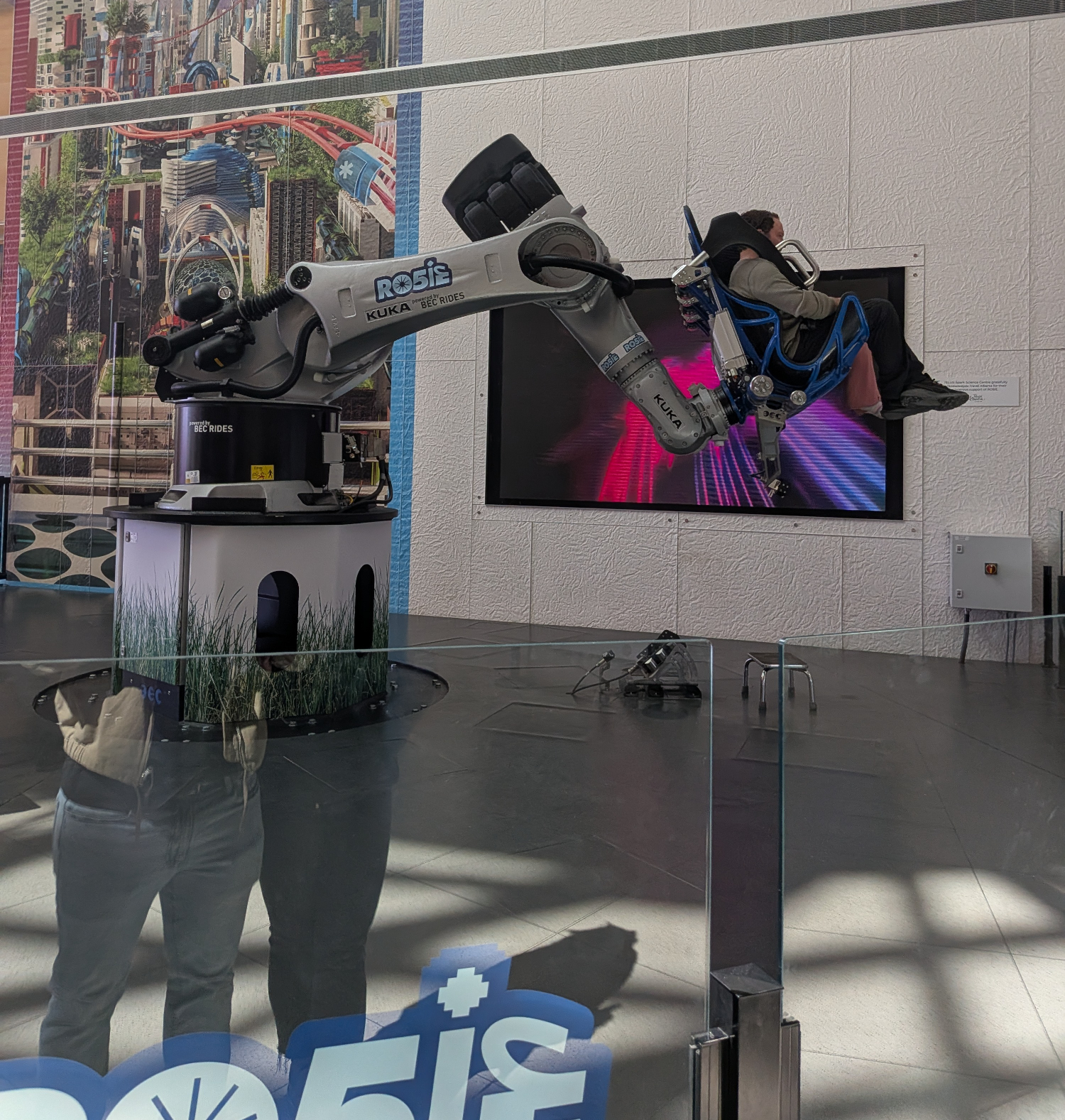
A rider experience built on a KUKA industrial robotic arm, branded "Rosie" and integrated by BEC Rides. A single guest is seated and restrained at the end effector of a large multi-axis industrial robot, which executes a pre-programmed motion profile. The robot is mounted on a dedicated pedestal with what appears to be a turntable base, enclosed within a glass safety perimeter. A large display screen behind the ride shows accompanying visual content.
What I Observed
The KUKA arm and BEC Rides branding are clearly visible. The robot was operational during my visit, with guests seated and restrained. The glass safety perimeter was clean and undamaged. An attendant was present to manage rider loading and unloading.
The seat itself is a custom fabrication mounted to the KUKA end effector, a multi-point harness with over-the-shoulder restraints and a leg support structure. This is the interface between industrial robotics and human factors, where the durability profile diverges from the rest of the system.
Durability Assessment
This installation represents a fundamentally different durability category from the other exhibits observed. The KUKA robot arm is an industrial platform designed for millions of cycles in factory environments, 24/7 operation, and high-precision repetitive motion, with OEM maintenance schedules and built-in diagnostic systems. The robot itself is not the durability concern.
The durability risk shifts entirely to the custom rider interface
The seat, harness, buckles, padding, and the mounting hardware connecting the seat assembly to the end effector.
The seat padding compresses under repeated loading from riders of varying weights. Harness webbing stretches and frays. Buckle mechanisms wear from thousands of insert/release cycles. The mounting hardware experiences fatigue loading from the dynamic forces of the motion profile; the robot can generate significant acceleration, and those loads are transmitted through the seat mount into the custom bracket on every ride cycle.
The pneumatic or hydraulic restraint lines are a critical safety system with a defined inspection interval. Unlike the robot's joints (which self-report wear through the KUKA controller), the custom restraint system relies on manual inspection and scheduled replacement. This is where maintenance discipline directly correlates with safety.
The staffed operation model is itself a durability feature.
Having a dedicated attendant for every ride cycle means the restraint system is visually inspected, however briefly, before each use. Unstaffed interactive exhibits do not get this continuous monitoring.
What a Durability Engineer Would Recommend
The seat assembly should have a defined replacement schedule for all soft goods (padding, webbing, covers) based on cycle count rather than calendar time, since rider volume varies seasonally. The mounting hardware connecting the seat to the end effector should be inspected for fatigue cracking at defined intervals using dye penetrant or magnetic particle inspection, standard aerospace practice applied to a consumer entertainment context. If not already in place, a cycle counter tied to the KUKA controller would enable condition-based maintenance rather than time-based maintenance.
Installation 4: VR Flight Platform
What It Is
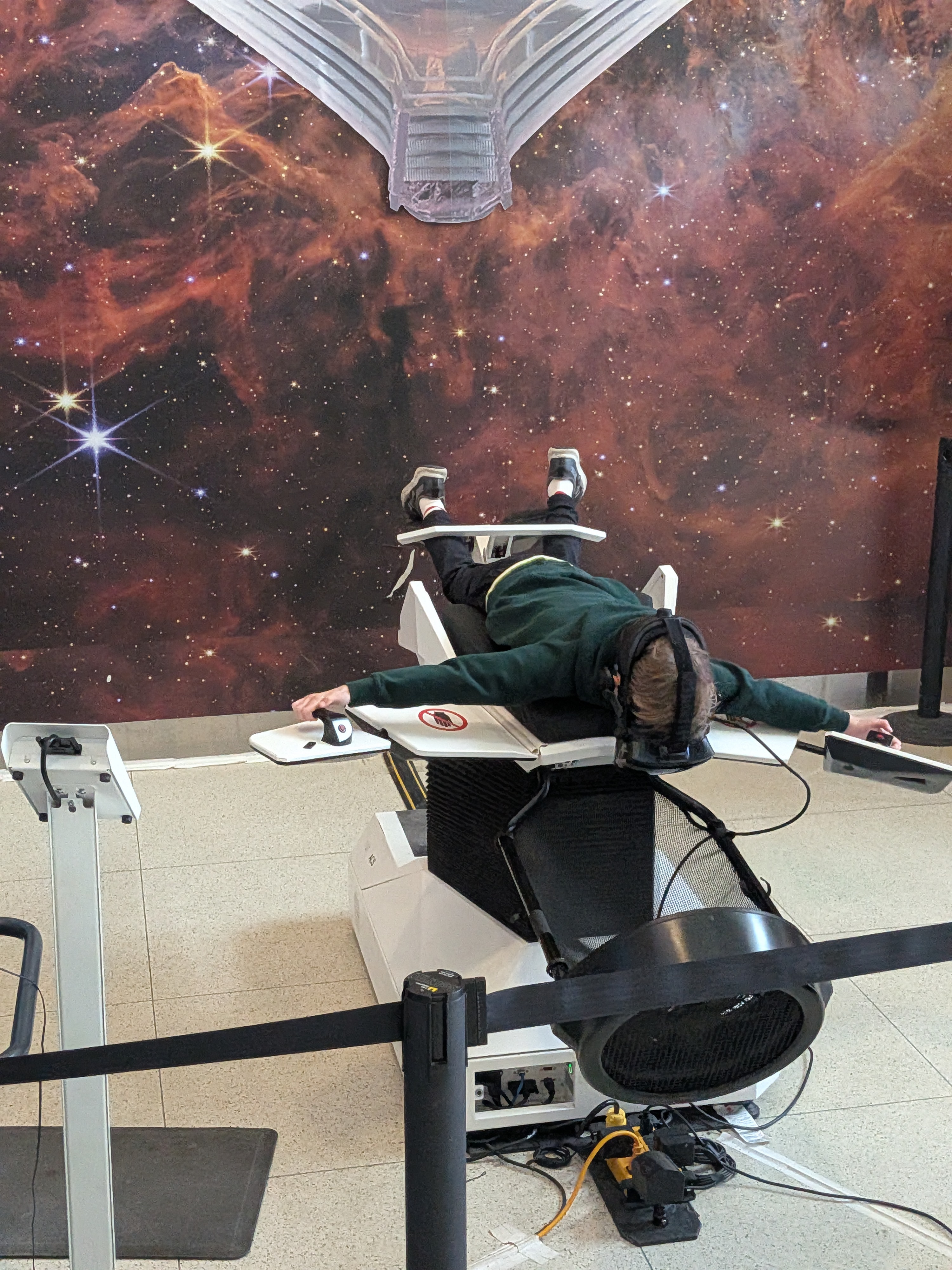
A prone-position VR flight simulator with a space exploration theme. The guest lies face down on a body-support platform, arms extended toward wing-like control panels, wearing a tethered VR headset. A large fan mounted at the front provides wind feedback. The backdrop features the James Webb Space Telescope's Carina Nebula image with the JWST depicted overhead.
The control scheme is biomimetic: the inner panels (closest to the body) are attached by hinges that allow a flapping motion, while the outer hand panels rotate around a connecting shaft that allows a twisting motion. Flapping likely maps to altitude or thrust in the VR environment; twisting likely controls roll, pitch or yaw.
What I Observed
The platform was in active use. The user was lying prone, arms extended, with the VR headset on and the fan running. A "do not push" sign was visible on one of the structural surfaces.
Cable management at the base was the first visible concern. Exposed power cables with yellow connectors were sitting on the floor near the pivot mechanism, unrouted, unsecured, and within foot traffic range. This is simultaneously a trip hazard, a snag point, and a power-loss failure mode.
The VR headset was tethered to the platform with the cable running across the user's body. No designated headset storage or docking station was visible during the between-user periods. The headset appeared to be a consumer-grade unit, not a ruggedized commercial variant.
The fan was running continuously during observation. It is positioned at face level for immersion, which means it continuously ingests dust, hair, and airborne debris through the floor-level intake.
Only one VR flight platform was installed, with no redundancy for downtime.
Durability Assessment
This is the most mechanically interesting installation of the four observed, and the one with the most durability concerns.
The hinge joints on the inner panels are the highest-stress components.
Every user flaps repeatedly throughout the session. These hinges bear the panel weight plus dynamic impact loads when users slam panels to their travel limits. Without elastomeric bumpers at the end of travel, shock loads transfer directly to the hinge hardware and mounting structure. Over thousands of cycles, this can produce either bushing wear (resulting in sloppy, imprecise motion) or fastener loosening (posing a safety concern).
The twist shaft connecting the inner and outer panels sees combined loading.
Users grip the outer panel and twist while simultaneously pulling, pushing, and leaning. The shaft experiences torsion, bending, and radial load simultaneously. A simple bushing interface here will develop play within months of heavy public use. Once there is perceptible slop in this joint, the control input feels imprecise, and the experience quality degrades, a functional failure even if nothing is structurally broken.
The "do not push" sign reveals a design gap.
In public installations, signage is not a structural member. If a surface requires a behavioral instruction to survive, the design did not account for user loads. A durability engineer would ask, "What happens when someone pushes despite the sign?" Does the surface deflect? Does a fastener take a load it was not designed for? The answer determines whether this is a cosmetic concern or a structural one.
The VR headset is the most expensive consumable.
Consumer headsets are not designed for public sharing. The facial interface padding absorbs sweat, makeup, and skin oils; the head strap stretches; the lenses get scratched; the tether cable gets kinked and twisted with every session. Without a designated docking station, the headset likely gets set down on whatever surface is convenient between users, increasing the risk of drops and cable damage. In commercial VR installations, headset replacement is typically the single largest recurring maintenance cost.
The continuous-run fan is a pragmatic durability decision.
Variable-speed fans synced to VR content are more immersive, but add a motor controller, a feedback loop, and speed-cycling wear. Running continuously eliminates those failure modes at the cost of immersion fidelity.
What a Durability Engineer Would Recommend
Priority one is cable management: route all power and signal cables through enclosed channels or cable trays, with strain relief at both ends. Priority two is replacing the twist shaft bushings with sealed bearings rated for the combined load profile, and adding elastomeric bumpers at the hinge end-of-travel limits. Priority three is a headset docking cradle that protects the unit, organizes the cable, and positions the headset for hygienic wipe-down between users. The "do not push" surface should be structurally reinforced or redesigned to withstand the loads users will inevitably apply, designing to the sign rather than designing away the need for the sign.
Cross-Cutting Observations
Across all four installations, several patterns emerge that apply broadly to interactive exhibit durability:
Most exhibits have a single component that defines its maintenance cost.
For the circuit builder, it is the alligator clips. For the KUKA ride, it is the seat soft goods. For the VR platform, the headset is the key. Identifying this component early in the design process and designing it for either extreme longevity or rapid replacement is the highest-leverage durability decision a team can make.
Signage is never a substitute for structural design.
The VR platform's "do not push" sign and the circuit builder's implied "please untangle the wires" expectation are indicators that the design assumes cooperative user behavior. Public installations must be designed for uncooperative, inattentive, and occasionally destructive user behavior. The question is always: what happens when someone does the thing you hoped they would not do?
Design separation reduces the failure blast radius.
The decoupled crane exhibits demonstrate that splitting a complex system into independent modules, even if it reduces the integrated experience, limits the impact of any single failure. This principle applies to all interactive installations: isolate failure domains so that a broken component takes down one function, not the entire experience.
Consumable component strategies only work with maintenance budgets.
The circuit builder's approach, accept that parts will wear out and plans for replacement, is valid, but only if the institution has staffing and budget to execute the replacement cadence. A consumable strategy without a maintenance budget becomes a degradation strategy.
Consumable component strategies only work with maintenance budgets.
The circuit builder's approach, accept that parts will wear out and plans for replacement, is valid, but only if the institution has staffing and budget to execute the replacement cadence. A consumable strategy without a maintenance budget becomes a degradation strategy.
About This Assessment
This case study demonstrates the type of observational durability analysis that Mbuyamba Engineering provides as part of its Independent Technical Advisory service. For commissioned assessments, our process includes access to design documentation, CAD review, material and fastener specifications, cycle-life testing data, and structured interviews with maintenance staff, resulting in actionable engineering recommendations with a quantified cost-benefit analysis.
For inquiries: consulting@mbuyamba.com
See our work
Real engineering problems, documented from challenge to solution.