The aerospace industry figured out how to verify production parts decades ago. Most hardware companies are still learning the same lessons.
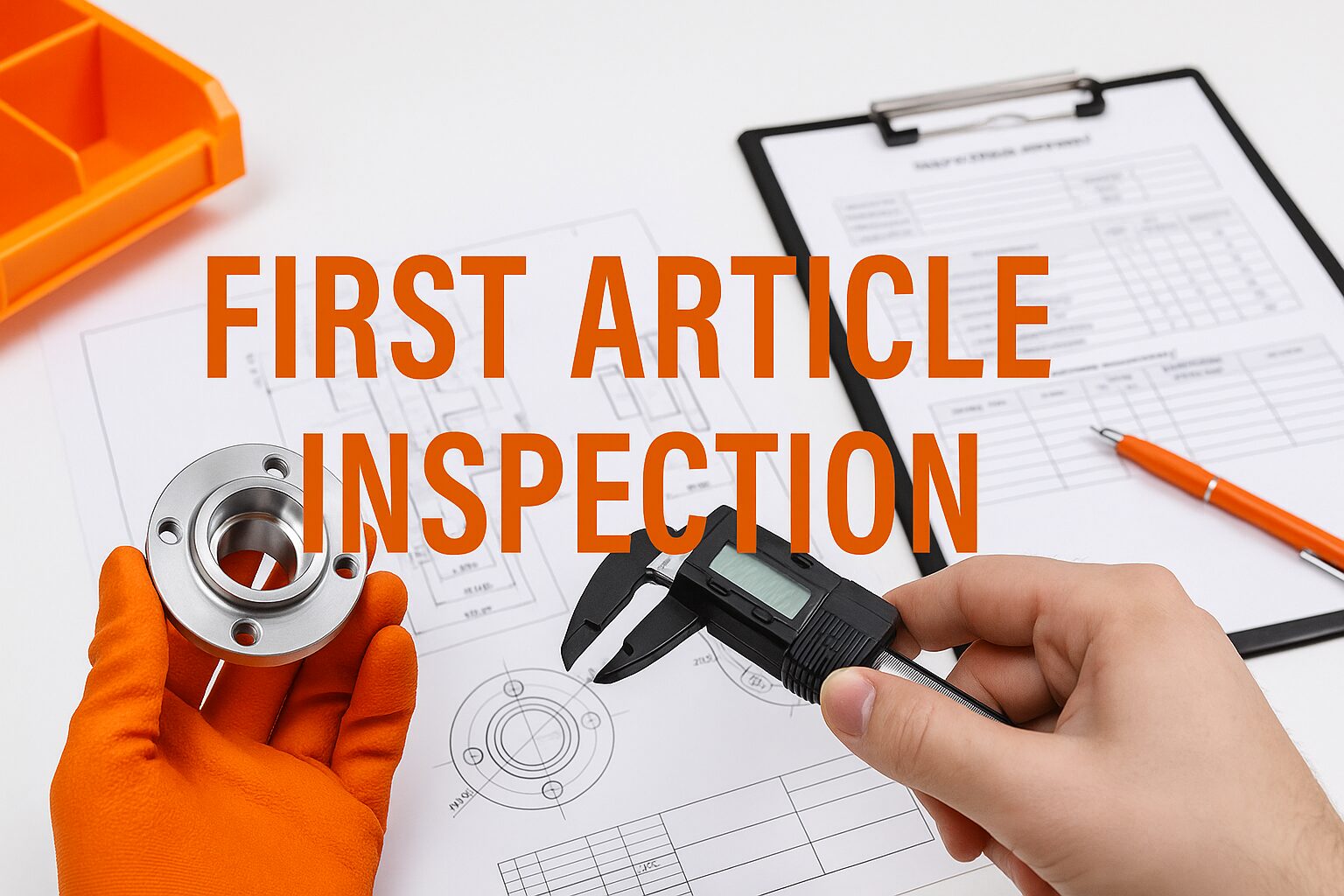
In aerospace, the first production part is treated as a hypothesis. It reflects your best engineering judgment about what the manufacturing process will produce. Before any part is accepted into service, that hypothesis is formally tested against the drawing, dimension by dimension and feature by feature. This process is called First Article Inspection (FAI). It is defined by AS9102 and is mandatory. In consumer hardware, the equivalent moment, when the first production sample arrives from the factory, is often treated as a celebration. It should be treated as a test.
What AS9102 is and why it exists
AS9102 is the aerospace standard for FAI. The FAI is a formal verification that the very first production part matches the engineering design, including every dimension, every material specification, and every process requirement. This process shows how closely the manufacturing process can match the designed part. FAI helps engineering teams identify where the manufactured part may fall short of the intended design before it goes into service. In my experience, having built an FAI framework for the team at my previous employer, I found that the FAI is a considerably overlooked tool for risk mitigation.
The Gap between Design and Production
This gap exists in every industry; however, it is taken most seriously in aerospace because the consequences are almost always fatal. Nothing is perfect. Every manufacturing process introduces variations. Material batches are cut to varying tolerances, and sometimes machine operators use different sequences to machine the same part. In reality, we cannot escape imperfection, but we can ensure that variations in manufactured parts remain within acceptable limits. By using the FAI and documenting every inconsistency found in the first manufactured parts, it is possible to eliminate variations and guarantee that future parts match the intended design. In consumer hardware, for example, the gap is discovered when parts don't fit together, don't work, or fail in the field.
Timing is important. Catching issues via FAI costs a few hours, but catching variations after 10,000 parts have been produced can cost you everything. The first part produced is the most important learning opportunity. It sets the baseline for everything that follows.
The five AS9102 Principles that apply to every hardware company
- Document the design intent before you verify against it
- It is important to document the design intent in as much detail as possible before performing formal verification. Every dimension should be clearly called out on the engineering drawing before the part is made, and an evaluation is done.
- Inspect the first article, not a sample of the first batch
- The first article is a proof of concept for the manufacturing processes. It is not meant to teach you what you got wrong about how the part is made. Do not treat this as a manufactured part but rather as a test of your production assumptions.
- Verify material and process, not just dimensions
- AS9102 addresses not only dimensions but also material processes such as heat treatment, surface finish, or plating. It is common for hardware teams to focus only on geometric variations and to skip special treatments.
- Document non-conformances, don't hide them
- The AS9102 requires formal documentation of all deviations. Use this opportunity to conduct an actual evaluation of what to change in the designed parts based on the results. Do not attempt to change the verification requirements at this stage.
- Use the FAI as a process validation, not a parts acceptance
- The goal here is not to approve this one part but to validate that the manufacturing process works reliably for the part/component. One good part is not enough.
What it looks like in practice
Creating a solid foundation is essential to any useful FAI. This means engineering drawings that clearly show every critical feature, with tolerances and limits. When the part or sample arrives, take the measurements, verify material and process certifications, test assembly fit, and confirm surface finish. Document the findings as in spec, borderline, and features that require tooling correction or modification. The next step is to confirm the action: accept for production, accept with tool correction pending, or reject and remake. To close the inquiry, a formal record should be made of what was found relative to the design intent and what was concluded as the corrective action.
Conclusion
The aerospace industry didn't develop AS9102 because its engineers are more careful than those in other industries. It developed it because the consequences of getting it wrong are unambiguous. Consumer hardware teams have the same gap between design and production; they just find it later, and the consequences are measured in customer returns, maintenance costs, and reputation rather than incident reports. The discipline transfers. The question is whether you apply it before or after the first failure.
Francis Kalonji Mbuyamba is the founder of Mbuyamba Engineering, a mechanical and aerospace engineering consultancy specializing in DFM review, durability engineering, and independent technical advisory for companies building physical products.
Preparing for production? Book a manufacturing readiness review.