May 5, 2026
Signage Is Not a Structural Member
A 'Do Not Push' sign on interactive hardware is not a safety measure. It is an admission that the hardware was not designed for the user it will actually encounter.

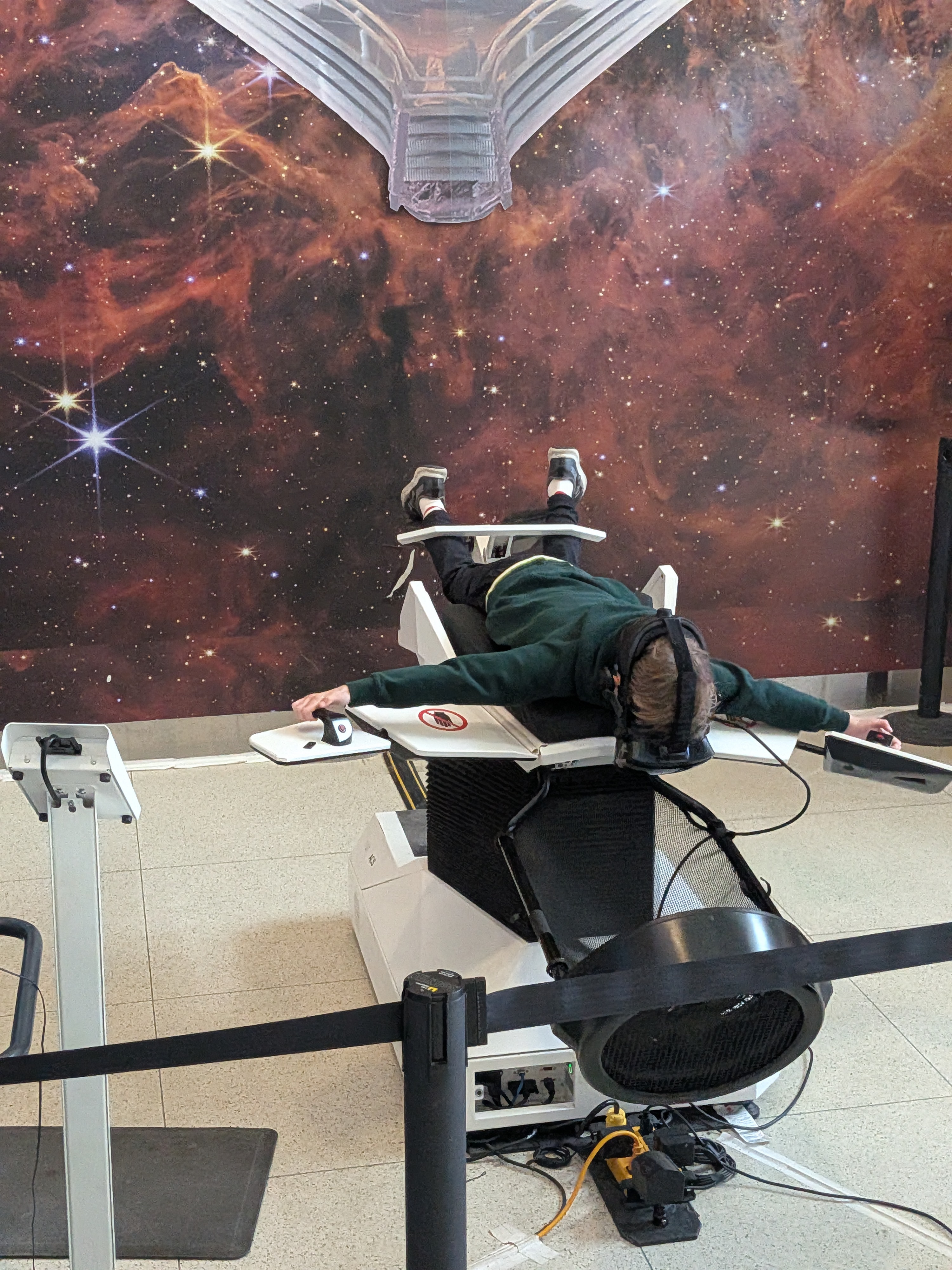
During a recent visit to the TELUS Spark Science Center in Calgary, I came across a VR flight simulation platform with a sign mounted to the front: 'Do Not Push.' The sign was professional and clearly placed. The first question that came to mind as an engineer was not 'will people read this?' It was 'why does this need to exist at all?'
The sign indicates that the hardware's users are interacting with it differently than the designer intended. The sign works on its own, but children don't always notice it as they excitedly climb onto the platform. Adults may lean while helping their children onto the ride. People may crowd around to see and accidentally push into unexpected places.
Placing the sign there is an admission that the hardware was not built for the real world. It is much easier said than done, but the objective is to always design for the user you will get, not for the user you want.
Signage is not a structural member. A label cannot carry a load. A warning cannot absorb impact. Only the mechanical design can do those things. The difference between a sign and a structural member is that structural members can be made safer using stronger materials and geometries, while a sign, no matter the material, color, or shape, cannot be made safer. If the hardware needs a sign to survive, the hardware needs to be redesigned. From what I saw, it looked like personnel were needed to ensure the designed hardware was not damaged in the field. An example of this is a case study I worked on for an attraction that needed to last 25 years. No signage like this was used because the structures were able to handle the real world and what users actually did. Every sign on an interactive installation is a design debt that hasn't been paid yet.
The platform in the photo above required on-duty staff to manage guest interactions with the hardware. That staff cost is a recurring operational expense that a better mechanical design would have eliminated.
Given the unpredictability of the real world, the costs can be understood as follows.
A structural fix before fabrication = hours of CAD time
A structural fix after installation = downtime, travel, labor, parts, and reputation
If you think about it, signs don't actually prevent failures the way we may intend. How can we design in a way that prevents that altogether?
Signs appear after something has already gone wrong. They are the cheapest possible response to a structural problem, and they rarely solve it.
Before your next interactive installation ships, ask this question about every element that will be touched by the public: if a child pushed on this as hard as they could, what would happen? If the answer involves a sign, redesign the hardware.
Francis Kalonji Mbuyamba is the founder of Mbuyamba Engineering, a mechanical and aerospace engineering consultancy specializing in DFM review, durability engineering, and independent technical advisory for companies building physical products.
Preparing for production? Book a manufacturing readiness review.
Our latest news and trending topics