Somewhere in an aerospace facility, a spin rig sits idle, mechanically sound but electronically obsolete. Bringing it back to life means bridging a 30-year technology gap without losing the engineering intent that made it work in the first place. Here's what that actually involves.
Why Spin Rigs Go Dark
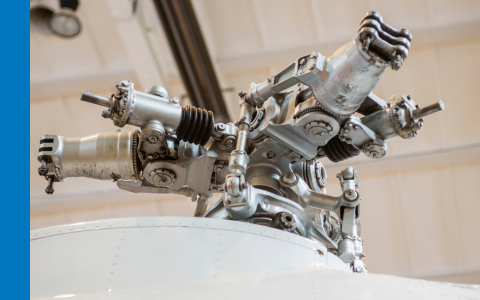
A helicopter blade spin rig, sometimes called a whirl tower, is a deceptively complex system. At its core, it's a high-energy rotating test platform: a large electric motor drives a gearbox, which drives a rotor head, which spins full-size helicopter blades at speeds up to 250+ RPM. The rig measures blade tracking height, pitch moments through load cells, and collective and cyclic pitch angles through encoders, all while managing the safety risks inherent in spinning multi-meter rotor blades in an outdoor or semi-enclosed environment.
These systems don't usually fail catastrophically. They die slowly, through obsolescence. The DC motor still works. The gearbox is still mechanically sound. The rotor head is a piece of aerospace-grade hardware that was built to outlast everything around it. What fails is everything else: the thyristor-based DC drive that nobody makes spare parts for, the control relay logic that predates PLCs, the analog instrumentation that drifts further out of calibration each year, the safety interlock wiring that has degraded from decades of outdoor exposure, and the institutional knowledge of how the system was designed to operate.
By the time someone decides to recommission the rig, the engineering challenge isn't rebuilding one system, it's bridging a 30-year technology gap while preserving the mechanical core that still works.
The Retain-or-Replace Decision
The first engineering decision in any spin rig recommissioning is what to keep and what to replace. This decision drives everything: budget, timeline, risk, and the complexity of the integration work that follows.
The mechanical core, the DC motor, gearbox, and rotor head, are probably worth retaining. These components were over-engineered from the start, built to aerospace standards, and designed for decades of intermittent high-load service. Replacing a 1000kW DC motor or a helicopter main rotor head is expensive, and the lead time for sourcing equivalent components can stretch into years. If inspection confirms they're mechanically sound, keeping them is the obvious economic choice.
Everything downstream of the mechanical core, however, is a candidate for replacement. The DC drive, the control system, the instrumentation, the safety interlocks, the HMI, the data acquisition system, the blade tracking system, the cabling, all of these can be modernized with current technology at a fraction of the cost of replacing the motor or gearbox. The challenge is that "modernize" doesn't mean "swap in new components." It means designing a new control and measurement architecture that interfaces correctly with legacy mechanical hardware that was never designed for modern digital systems.
The DC Drive Problem
If the original spin rig used a large DC motor, and most did, because variable-speed DC drives offered the precise speed control needed for blade balancing before modern VFDs became capable enough, then the DC drive replacement is typically the single most complex subsystem in the recommissioning scope.
A legacy spin rig DC drive was often a custom thyristor-based system, purpose-built for the specific motor's armature voltage, current, and excitation requirements. Replacing it with a modern DC drive means matching the motor's electrical characteristics precisely: armature voltage (often 400-800 VDC), armature current (potentially over 1000 amps), excitation voltage and current, and the speed control dynamics required for smooth acceleration and deceleration of a high-inertia rotating load.
The substation and power distribution infrastructure upstream of the drive may also need evaluation. Legacy systems often drew power through high-voltage transformers sized specifically for the original drive topology. A new drive with different input requirements may need transformer modifications or replacement, an expensive and time-consuming change that is easy to overlook in early scoping.
The tachometer or encoder on the motor shaft is another common failure point. Original systems often used analog tachometer generators that provided speed feedback to the thyristor drive. Modern DC drives expect digital encoder feedback. This means either replacing the tachometer with a digital encoder (which may require mechanical modifications to the motor shaft coupling) or adding a signal conditioning layer between the legacy tachometer and the new drive.
Instrumentation and Measurement
Blade balancing demands high measurement accuracy. Typical requirements include blade height tracking accurate to ±1mm, pitch angle measurement to fractions of a degree, pitch moment measurement through calibrated load cells, and RPM accuracy within ±1 RPM. These are not unusual specifications for aerospace measurement, but achieving them on a legacy mechanical platform with new instrumentation is harder than it sounds.
The primary challenge is signal routing. In most spin rigs, all measurement signals from the rotating assembly pass through a multi-channel slip ring, an electromechanical device that transfers electrical signals from the rotating shaft to the stationary control room. Slip rings degrade over time, introduce noise, and have a fixed number of channels. A recommissioning project needs to evaluate the condition of the existing slip ring, determine whether its available channels can accommodate the new sensor configuration, and assess whether the signal quality is adequate for the measurement accuracies required.
The alternative to a slip ring is wireless telemetry, transmitting measurement data from the rotating assembly via radio link. This eliminates the slip ring as a failure point and offers more flexibility in sensor placement, but it introduces its own challenges: power supply to the rotating transmitter, electromagnetic interference from nearby industrial equipment or airport radar, data latency, and the cost of aerospace-rated wireless instrumentation.
Safety Systems
A spin rig is one of the highest-energy mechanical test systems in any aerospace facility. A set of helicopter main rotor blades spinning at operational RPM stores an enormous amount of kinetic energy. A blade release, structural failure, or overspeed event at full RPM would be catastrophic, not just to the equipment, but to anyone in the vicinity.
Legacy safety systems on spin rigs were typically hardwired relay logic: physical microswitches on access gates, emergency stop buttons wired directly to motor contactors, and mechanical overspeed trips. These systems were simple, reliable, and well-understood, but after decades of exposure to weather, vibration, and neglect, the wiring, switches, and connectors may be degraded beyond trustworthy operation.
A recommissioned spin rig needs modern safety systems that meet current standards while preserving the fail-safe philosophy of the original design. This means safety-rated PLCs with redundant shutdown paths, certified emergency stop circuits, overspeed protection with independent monitoring, and interlocks that physically prevent motor start when access gates are open or when blades are not properly secured. The safety system design must account for every credible failure scenario, including loss of electrical power, loss of cooling water, loss of control system communication, blade detachment, and structural failure of the support structure, and ensure that the system reaches a safe state under each scenario without operator intervention.
The Multi-Blade-Type Challenge
Many legacy spin rigs were configured for a single helicopter type. The rotor head, blade attachment fixtures, pitch control geometry, and measurement parameters were all designed around one blade model. As helicopter fleets evolve and maintenance organizations take on work for multiple aircraft types, there's often a requirement to extend the rig's capability to balance blades from different helicopters.
This is not a trivial modification. Different helicopter types have different blade lengths, different blade root attachment geometries, different pitch control mechanisms, different operational RPMs, and different OEM-specified balancing procedures. Accommodating multiple blade types on a single rig requires configurable blade attachment fixtures, adjustable blade tracking systems that can accommodate different blade lengths, configurable control parameters for each blade type's operational RPM and pitch range, and separate calibration profiles for each configuration.
The HMI and data management system must also support multi-type operation, storing blade-specific parameters, generating type-specific reports, and ensuring that operators cannot accidentally apply the wrong configuration to the wrong blade type.
The Human Factor
Perhaps the most underappreciated challenge in spin rig recommissioning is the loss of institutional knowledge. The engineers who designed the original system are retired or gone. The technicians who operated it daily for decades have moved on. The OEM documentation, if it still exists, may be incomplete, outdated, or written in a language that assumed familiarity with systems and procedures that no one in the current organization has ever seen.
This means that a recommissioning project is not just an engineering project, it's also a knowledge recovery project. The team doing the work needs to reverse-engineer not just the hardware, but the operational philosophy: why the system was designed the way it was, what the critical parameters are and why they matter, what the failure modes are and how the original designers mitigated them, and what the operational procedures assume about the operator's training and experience.
Without this context, there's a real risk of building a technically functional system that is operationally unusable, or worse, one that appears to work correctly but produces subtly inaccurate results because a critical design assumption was missed during the modernization.
Why This Work Matters
Helicopter blade balancing is not optional. An improperly balanced blade set creates vibrations that accelerate fatigue in the rotor head, transmission, and airframe. Over time, these vibrations can lead to component failures that are expensive at best and catastrophic at worst. The spin rig is the quality gate that prevents this , and when the spin rig is down, blade balancing either doesn't happen or gets outsourced at significant cost and logistical complexity.
Recommissioning a legacy spin rig is one of those engineering projects that sits at the intersection of mechanical engineering, electrical engineering, control systems, aerospace standards, and safety engineering. It requires the kind of engineer who can look at a 30-year-old mechanical system, understand why it was built the way it was, and design a modernization path that preserves what works while replacing what doesn't , without losing the operational intent along the way.
It's not glamorous work. But it's the kind of work that keeps helicopters in the air.
Francis Kalonji Mbuyamba is the founder of Mbuyamba Engineering, a mechanical and aerospace engineering consultancy specializing in durable hardware design, manufacturing readiness, and independent technical advisory. He holds dual degrees in Mechanical and Aerospace Engineering from West Virginia University.
Have a legacy test system that needs modernization? Get in touch.
Other Research
What else do we think about at Mbuyamba Engineering?