Size the Motor for the Friction, Not the Fingertip: Designing a tendon-driven robotic hand from first principles
The hand is where humanoid robotics gets hard: many moving parts, tight packaging, real forces, and strict weight limits at once. Most designs start from a target spec and work backward. I'd start from the physical laws that govern any tendon-driven hand and let the design follow, because those laws form a chain, and each decision constrains the next. Trace it in the right order and the hard part surfaces on its own.
Humanoid robots have largely solved locomotion; manipulation is the open problem, and the hand is where it concentrates. Industry figures now routinely call the hand the hardest part of the machine; Tesla's Optimus program has put it at roughly 60% of the robot's total engineering difficulty [4]. The most capable hands in 2026, 1X's 25-DoF NEO hand and Figure's 16-DoF design, are hard precisely because the hand concentrates the difficulty: dozens of degrees of freedom, human-scale packaging, forces in the tens of newtons, all light enough to hang off a moving arm. The field agrees on tendon drive with forearm-mounted motors and diverges on nearly everything after that, so what follows is a set of defensible positions, not a consensus.
Content
Start with the force, because everything scales from it
The force becomes tendon tension, set by the moment arm
A tendon only pulls, which sets how many cables there are
Degrees of freedom are not motors
Why the motors are in the forearm at all
Every decision ends at a toleranced part
It's one problem
References
Start with the force, because everything scales from it
One number enters from outside the physics: how hard the fingertips must pinch. It's tempting to read it off a competitor; 1X's NEO hand reports distal forces up to about 45 N [4], but that number describes their hand, not the task. Lets derive it.
The task is holding an object without dropping it. Friction at the two fingertip contacts must resist the object's weight with a margin against slip, which sets a floor: pinch force ≥ weight × safety factor, divided by twice the fingertip friction coefficient. With a rubberised pad (coefficient ~0.5) and a 2× margin, 30 N holds about 1.5 kg: most hand tools, bottles, small parts, light boxes. The field's 30–45 N band then checks the result instead of setting it.
Two things follow. The target depends entirely on the friction assumption: at coefficient 0.3, for a smooth or greasy object, 30 N holds barely 0.9 kg, which is the case for tactile sensing, since a hand that feels slip grips just hard enough instead of crushing to be safe. And human key-pinch strength runs near 115 N for men, 75 N for women [3], so 30 N is deliberately sub-human, sized to do the task with margin, not to be maximal.
This 30 N is the seed. Every force downstream scales from it.
The force becomes tendon tension, set by the moment arm
A tendon moves a joint by pulling at some distance from the pivot, the moment arm, which converts tension into torque. A larger arm gives more torque per unit tension, but the cable must travel further to rotate the joint the same angle. Torque and travel trade directly; no moment arm gives both.
So the fingertip force from the previous section doesn't fix the tendon tension on its own; the moment arm does. A tight arm keeps the joint fast but multiplies the tension the motor must supply; a generous arm cuts the tension but demands a longer pull. I'd set the arm per joint against what that joint does, and record the tension it implies, because that tension is the next input.
A tendon only pulls, which sets how many cables there are
A cable pulls; it can't push. One tendon moves a joint one way, so curling a finger and straightening it needs either an antagonist tendon pulling back or a spring that returns the joint when the driving cable relaxes.
That choice sets how many cables cross the wrist: between sixteen and thirty-two for a sixteen-DoF hand. My rule: springs for motions that only reverse, antagonists for motions that must hold position under load. That roughly halves the count, and every cable removed is a pulley, a guide, and a wear path not built: a cost and reliability gain at volume, not only a mechanical one.
Degrees of freedom are not motors
Cable count isn't motor count either. A human finger has three joints and nothing like three muscles driving them independently; one tendon curls all three together, and the finger conforms to what it holds. That's underactuation, and it's what makes a dexterous hand buildable: one motor per degree of freedom would mean sixteen motors in a forearm, which won't fit and isn't needed.
This can be blurry so lets state it precisely: kinematic DoF (axes the hand can move) and actuated DoF (axes with a motor) are different numbers, and a spec quoting one without saying which tells you less than it appears to. The distinction is real enough that 1X's own product lead has argued a degree of freedom you cannot actuate and feel is a datasheet number, not a capability; many advertised counts include passive, spring-loaded joints [4]. "25 DoF, 22 actuated" is the honest form. I'd make the kinematic count generous where it's cheap (one motor can spread four fingers) and spend actuators where independent control earns it: the thumb and index, which pinch and do fine work. Cable count and motor count together answer one question: whether the hand packages into the forearm at all.
The motor is sized by friction, not by fingertip force
Now the two chains meet. Tendon tension came from the force and the moment arm. But the motor doesn't see that tension; it sees that tension amplified by friction, and the amplification is not small.
Every time a tendon wraps a curved surface (a pulley, a guide, the inside of a curled finger), friction resists it, and the losses multiply exponentially with total wrap angle. This is the capstan equation, the physics that lets a sailor hold a ship with a rope looped around a bollard: output tension equals input tension times e raised to (friction coefficient × wrap angle). The wrap angle is in the exponent.
Figure 1. Tendon tension amplification versus total wrap angle (capstan equation, F = F₀·e^μθ). The shaded 90–300° band is a real finger-plus-wrist path; rougher routing (μ = 0.2) nearly triples the tension a motor must supply, while good routing (μ = 0.1) holds it under 1.7×. Coefficients illustrative.
This is how we describe the hardware. The German Aerospace Center (DLR) notes that anthropomorphic hands put motors in the forearm to reduce finger size and increase dexterity, at the cost of substantial friction from routing tendons over multiple pulleys; the cables to distal joints pass the proximal ones and pick up friction at every pulley and edge [1]. Reported coefficients run from about 0.04 for a good cable [2] to much higher for rough contact. Even at the low end the exponential bites.
So the motor is sized to the worst-case wrapped path, not the fingertip force, and the routing geometry becomes a design variable; that's where the exponent is won or lost. This is an active area of patent filing: Tesla's Optimus hand patents claim a wrist routing geometry that reduces cable stretch, friction, and crosstalk, and surgical-robotics filings explicitly shape tendon contact surfaces on the link bodies to avoid higher-friction bore routing [5]. The industry is spending legal budget on that exponent.
Why the motors are in the forearm at all
Friction is the price of a prior decision, so it's worth making that decision explicit. Mass at the fingertip is the most expensive mass in the machine: a gram at the tip is accelerated by every joint below it and carried, swung, and stopped by the whole arm above it, costing speed, safety, and motor torque at every joint. So the motors go to the forearm, near the arm's rotation axes where weight costs least, and the hand carries only links, pulleys, and anchors [1].
That move is what forced the tendons across the wrist, which is what compounded the friction two sections up. Tendon drive isn't better in general; it's better here. A motor in each joint gives cleaner control and no routing friction, which is why robot arms, with few large joints near the body, commonly use motor-in-joint or quasi-direct drive. The hand is the opposite case on every axis: too many joints, too little volume for strong motors, all at the far end of the longest lever in the robot. This is exactly why the current tendon-hand patents from Tesla and others relocate the actuators to the forearm, to cut the hand's mass and inertia [5]. Same physics, opposite answer. The friction penalty is accepted knowingly, to win on mass.
Every decision ends at a toleranced part
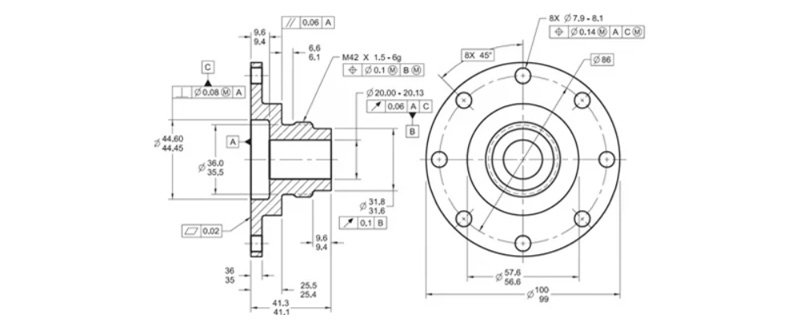
The chain resolves into hardware or it resolves into nothing. Each decision above is a feature on a part with a process and a tolerance. The links carry the tendon-anchor and pulley features whose positions set the moment arms, so those dimensions get tight geometric tolerance and clear datums; the cosmetic surfaces don't. A finger link, where load and precision concentrate, is a CNC or metal-print part; a palm shroud is molded or printed. Tolerancing only the features that control function, to ASME Y14.5, is how the physics becomes a BOM someone can quote and a drawing a machinist can hold. A moment arm is only as real as the tolerance on the hole that locates it.
It's one problem
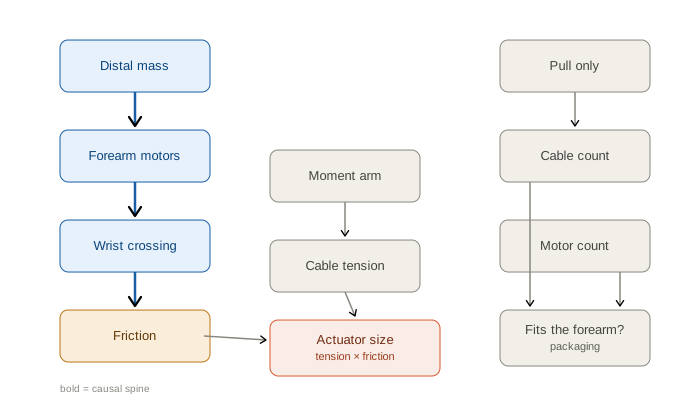
Read in order, the chain is a single line of causation. A task sets the fingertip force. The moment arm turns that force into tendon tension. Pull-only sets the cable count; underactuation sets the motor count; together they decide whether it packages. The drive to keep mass off the hand puts the motors in the forearm, which sends the tendons across the wrist, which compounds friction, and friction multiplies the tendon tension into the force the motor must actually supply.
Figure 2. The five constraints as one dependency chain. The bold spine, distal mass → forearm motors → wrist crossing → friction, is the causal heart: keeping mass off the hand is what creates the friction problem. Friction and cable tension converge on actuator size, where they multiply. Cable count and motor count feed a separate question: whether the hand packages into the forearm at all.
The collision is the whole problem. Tendon tension runs to hundreds of newtons; friction multiplies it; multiply them without thinking and the motor fits no forearm ever built. Size each part in isolation and you meet that collision at assembly. Trace the chain and you meet it at the start, which is the only place it's cheap to fix.
References
[1] F. Lange, M. Pfanne, F. Steinmetz, S. Wolf, and F. Stulp, "Friction Estimation for Tendon-Driven Robotic Hands," IEEE/RSJ International Conference on Intelligent Robots and Systems (IROS), 2021. German Aerospace Center (DLR). Forearm-mounted actuation, tendon routing through the wrist and across proximal joints, and the resulting multi-pulley friction.
[2] Design, modelling and experimental evaluation of a tendon-driven wrist mechanism for an upper-limb exoskeleton, arXiv preprint, 2026. Applies the capstan equation F_out = F_in · e^(μθ) to cable-sheath friction, adopting μ ≈ 0.04 for Bowden-cable actuation.
[3] V. Mathiowetz, N. Kashman, G. Volland, K. Weber, M. Dowe, and S. Rogers, "Grip and pinch strength: normative data for adults," Archives of Physical Medicine and Rehabilitation, vol. 66, no. 2, pp. 69–74, 1985. Standard normative dataset (638 adults); adult key-pinch strength averages ~115 N (male) and ~75 N (female), used to calibrate the pinch target.
[4] 1X Technologies, NEO dexterous hand specifications, announced July 2026 (as reported by Forbes, Interesting Engineering, and others): 25 degrees of freedom (22 actuated in fingers and palm, 3 at the wrist), quasi-direct-drive tendon system with 5:1–15:1 gear ratios, distal flexion force up to 45 N, ±0.2 mm positioning. Also the source for the actuated-vs-passive DoF distinction. Figure 02 hand: 16 DoF, per Figure public materials.
[5] Tendon-routing friction as a patent-active problem: Tesla "Mechanically Actuated Robotic Hand" and related Optimus patents (filed Oct 2024, published internationally 2026) claim forearm-relocated actuators and a wrist routing geometry that reduces cable stretch, friction, and crosstalk; Medical Microinstruments' 2023 surgical-instrument filings engineer tendon contact surfaces on link structures to avoid higher-friction bore routing. Summarised in the 2026 tendon-driven-hand patent landscape (Patsnap) and Tesla patent reporting.
Field figures for the 1X NEO and Figure 02 hands are from public manufacturer announcements and reporting as of mid-2026; see [4].
This opens a full design study of an anthropomorphic hand: kinematics, actuator sizing, tendon routing, joints, materials, and manufacture, with the tolerancing and DFM this summary only points at. A notional study, not production hardware.
Other Research
What else do we think about at Mbuyamba Engineering?

.svg)